Search This Blog

Sunday, March 25, 2007

Thoughts: Army of Darkness


“You ain’t leading but two things right now, Jack and Shit, and Jack just left town.”

So do I even need to mention that I love this movie? Or that I love Bruce Campbell? Or that when my mom tells me that she has never seen an Evil Dead movie I decide to sit her down immediately and show her Army of Darkness? I actually would have showed her all of them but Army of Darkness was the only I brought to Florida with me.

The movie is fantastic. It’s hilarious and full of slapstick, it’s got great lines, it’s got deadites, and it’s got lots and lots of Bruce Campbell. And a good amount of Bruce Campbell in half of a shirt. I enjoyed that.

What can I even say about the movie other than the fact that it’s great? It’s a cool, cool movie that’s not scary at all. At least I don’t think it is. But I’m not sure anyone could think it was really that scary with Ash being all Ash-like. Klaatu, Barrata, Necktie… cough, cough… There… I said the words…

Now was it just me, or did anyone else notice the ridiculous similarity between the beginning of the graveyard scene with Evil Ash and the part in Return of the King in front of Minis Morgul. Peter Jackson used almost the exact same shots when he does his freaky, dutch angel, zoom in on the statues right before the army comes marching out of the city as Sam Raimi uses right before his Skeleton Army leaves the graveyard to attack Ash and his primitive screwhead buddies. I thought that was nifty.

Man, the charge on my computer is going down fast. I think I’m gonna shut this down now so I can get some sleep. And while I’m sleeping you should go watch Army of Darkness. It’ll be a good time.

Hail to the King baby.

Saturday, March 10, 2007

Analysis: Close To Eden


Close to Eden, or Urga, is a film about change. Gombo lives on the border of two lands, China and Russian, and he lives on the border between two times. Close to Eden explores the changing times and one of the most important characters in this exploration is the land itself.

The land becomes a character itself by the way Mikhalkov represents it with his camera. The way his camera wonders away from the action of the film and becomes lost in the hills and grass seems to imply that the land is more important than whatever may be happening to the people that live there. As Ghosh and Sarkar say in their article “The Cinema of Displacement: Towards a Politically Motivated Poetics,” “land is a cultural repository of memories and symbolic of a way of life. The point is made by the camera’s repeated privileging of landscape over action. Often, the camera will focus for several seconds on the plains, and all action is suspended.”

Gombo is a part of this land. He is of Mongolian descent and belongs himself more to the past than the present. He speaks fondly of Genghis Khan and hopes to have another son becomes Khan was a fourth son. His wife, a city girl, tries to persuade him to become a part of modern times. She insists he travel to buy condoms and a television set. When he enters the city, he obviously does not belong to it. He rides through on a horse and looks horribly out of place.

He finally makes the return trip with the television in tow, but he feels guilty about succumbing to the lures of the modern times. Ghosh and Sarkar point out a dream sequence he has on his return trip that illustrates his guilt. “The narrative repeatedly raises questions of home and its loss: in a Chinese nightclub, Sergei sings of the ‘Hills of Manchuria’; Gombo’s wife puts on her ancient Mongolian head-dress and gazes onto a glorious historical past and a disappeared ‘home’; Gombo himself has visions of Genghis Khan’s revenge on him because he is on the brink of forsaking his heritage.”

As they have pointed out, it is not only Gombo that is uncomfortable with the changing times, all of the characters of the film are anxious. All want to remain in the past where their roles and places are familiar. The end represents this past and familiarity. While everything around them has changed, the land has not. The green hills and the swaying grasses are timeless. However, the times are changing and the present enters Gombo’s home even in the midst of the timeless land around it.

Sergei, Gombo’s wife, and their neighbor all bring the modern to Gombo. Sergei is a Russian truck driver and brings another cultural to the land with his truck that cuts across it, leaving its tracks in the grass. Gombo’s wife brings the present in with her insistence that he buy a TV and birth control. Gombo’s neighbor brings souvenirs to Gombo, including an American movie poster. Gombo cannot resist the influx of the modern into his life; it comes from too many angles.

Gombo is a part of his land and of the past. Ghosh and Sarkar describe it as “’Home’ for Gombo is literally a humble shack surrounded by an undulating landscape where he grazes his horses. The open plains, seemingly unmarked by signs of ownership, are sometimes staked out as personal: Gombo plants his urga as a sign of privacy when he makes love to his wife on the grass.” Gombo is a part of the land. The only ownership that is ever claimed is that that they note, when he is making love to wife, an act that is as timeless and natural as the land itself.

The natural act of lovemaking is under attack in the film. Gombo’s wife does not want another child so she urges him to buy condoms. China has put limitations on how many children you may have, and Gombo has already exceeded that number. While he insists he is not a part of China so the law does not apply to him, he cannot ignore the urgings of his wife. His wife finally wins out and he goes to buy the condoms. However, in the end he does not succumb, he does not buy them and tells his wife that they were sold out.

He has however bought the television. He cannot resist all of the changes that are occurring and he cannot completely block out the modern world. As lovemaking has come under attack, by the end of the film so has the land. The final shots of the land that represented the richness of Gombo’s past are of a land that is no longer green and isolated from the world. The hills are covered by the tracks of trucks and a giant smokestack fills overwhelms the horizon. Gombo’s son works at a near by gas station and it seems that despite all of Gombo’s resistance to it, the present has overwhelmed the past.

Monday, January 08, 2007

Review: Children of Men


She would never say where she came from

Where does our humanity come from? When does the face in a crowd become more than just a face? What does it take to get us to connect with someone on an emotional, personal level?

In the terms of a film, where is the line between caricature and character drawn? When does the person on screen become more than just an actor playing a role? Where does empathy begin? When does humanness start?

Yesterday don’t matter if it’s gone

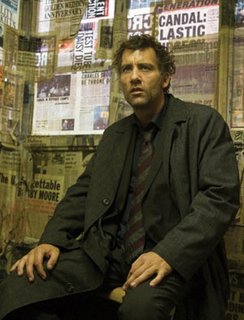
There is a moment in Alfonso Cuaron’s Children of Men where our hero Theo (Clive Owen) asks his cousin why he still bothers to save important pieces of art from destruction. Why bother when in a hundred years no one will be alive to see it? His cousin’s answer: he’s just stopped thinking about it. It has no meaning; it is just an exercise to keep himself busy. Even a task that would seem to be noble, seem to be culturally significant, becomes meaningless when there is no future, no one to appreciate it.

Lose your dreams and you will lose your mind

Children of Men is a bleak film. Set in the year 2027, it’s a vision of the future that brings to life our darkest fears. The human race is dying. The end is not a product of war; it is not a result of global warming or some other environmental catastrophe. The human race is dying because of a flaw within: women can no longer have babies. It has been 18 years since the last child was born and the world has collapsed into hopelessness and chaos. Britain alone can make claims of order and maintained social structure. However, order is a relative term. Bombs explode in coffee shops and illegal immigrants, people called “fugees”, are hunted down and rounded up like vermin.

On the grey streets of London, Theo is just another man in the crowd. He’s an alcoholic dragging through the horror that has become everyday life. That is until his love from a life long past grabs him off of the street and asks for his help. Julian (Julianne Moore) needs him secure travel papers for two women, the fugee Kee and the midwife Miriam (Pam Ferris). For motives never made completely clear, Theo agrees to aid them. In doing so, he discovers that there may be something in the world worth fighting for after all.

While the Sun is Bright


If you’ve read my review of A Little Princess then you may already know that I’m a huge fan of director Alfonso Cuaron and cinematographer Emmanuel Lubezki. They worked together previously on both A Little Princess and the highly regarded Y Tu Mama Tambien. Additionally, Cuaron is well known for Harry Potter and the Prisoner of Azkaban while Lubezki’s other credits include Terrance Malik’s The New World, Tim Burton’s Sleepy Hollow, and, one of my personal favorites, the beautiful Like Water for Chocolate.

However, Children of Men is different from their previous films. Where many of their past works have hinted at the darker side of life, they all remain bright and hopeful. There is color and there is life. In Children of Men, the opposite is true. While there may fleeting glimpses of a sun lit park or a bright sunrise, the landscape here is desolate and grey. Even if hope is rediscovered in the end, color never is. A world without color is a sad one indeed.

In the darkest night


A world shrouded in sorrow has its own beauty. A man may rediscover his humanity and hope may be born again. The people of Children of Men always seem to maintain a distance from the audience, from each other, from themselves but this distance in ways serves to make them not characters but humans. How can we ever truly know what another person’s motives are? We may never discover exactly why Theo decided to help Julian and Kee, but in the end the why doesn’t matter. His why doesn’t matter, nor does Jasper’s, Marichka’s, or Miriam’s. What it comes down to is that in a world gone mad, humanity still exists. Heroes can be real.

This vision of chaos cannot escape from the parallels to our current society. The story is an allegory made all the more relevant by the acts of terror, the acts of war, the acts of genocide, and the intolerance that have plagued us in the recent past. While PD James’s novel may have been moving when it was released in 1992, Cuaron’s film is like a look in the mirror. It’s impossible to watch without seeing the unpleasant truths we turn away from in everyday life.

What is Truth? Sometimes it’s easier to discover through works of fiction than through statements of fact.

Don’t question why she needs to be so free


Of course in troubled times there is never a lack of films exploring our anxieties and fears. What sets Children of Men apart from the other distopian films of recent years (i.e. V for Vendetta) is how it handles the material. While V may paint a dark picture of the future, it is still a slick high budget affair concerned more with showcasing flashy explosions and Natalie Portman’s pretty face than anything else. V was made to entertain. Children of Men was made to tell a story.

Lubezki embraces a pseudo documentary approach using natural sources of light and allowing the camera to film whatever image its attention is drawn to. In one scene, Theo walks through the woods and for a moment the camera is distracted. Rather than follow Theo, it glances up and gives us a dizzying view of the heights of the trees. In another scene, there is a moment when two officers are shot after a violent car chase. The camera jumps out of the car with Theo but when Theo leaves, the camera lingers on the officers allowing us to absorb the shock of this sudden violence.

The way the filmmakers photograph the violence in the film is one of their greatest achievements. They manage a rare thing: there is no glorification. My biggest complaint against films like Saving Private Ryan is that their claims of an anti-war stance is a lie. They use violence to sell tickets and make war seem something to be desired. For me, most war films dishonor those on the front lines by turning war into a commodity, a source of entertainment.

Children of Men may be violent, it may have deliberate parallels to current atrocities, but it never lusts after these things. The story is one that fully embraces humanity and the images that linger in my mind are not the moments of blood and gore but the images Theo’s pain filled eyes and Kee’s hopeful face. Children of Men is a story not about violence, it’s about the people that are living through it.

While I certainly wouldn’t say the film is flawless, I do think that is one of the best of the last year. There’s a beauty in its starkness and an honesty and poignancy in its story telling. It touched my heart and moved my mind. Lubezki’s cinematography is some of the best I’ve seen and Cuaron once again succeeds in making a work of art into a vision of humanity.

Goodbye Ruby Tuesday
Who could hang a name on you
When you change with every new day
Still I'm gonna miss you.

Wednesday, December 27, 2006

Review: Black Christmas (2006)

x-posted at Epinions


I don’t like remakes. Really, really I don’t. So when I saw that a remake of Bob Clark’s 1974 classic horror film Black Christmas was in the works, I was not happy. However, when I found out Glen Morgan was attached to it I felt a bit of hope. I admit it, I have a long time affection for Morgan and his frequent partner in crime James Wong. You might even go so far as to call it a crush. Ever since I discovered them through some of my favorite X-Files episodes I’ve followed both of their careers. Yes, I even like Final Destination.

While Wong was not involved in this particular film, Morgan did direct and have a role in the writing of the screenplay. As far as it goes, the film is entertaining. Even as a fan I have to admit that Morgan’s films are not necessarily brilliant but they are all competently done and I always find them to be great fun. Black Christmas is no different.

Granted, the remake cannot compare to the original but at least it’s not a complete atrocity (TCM remake anyone?). The story is more or less the same. It’s Christmas Eve and a killer terrorizes a sorority house. Girls begin to disappear and mysterious, threatening phone calls keep being made from their cell phones. Trapped by a snowstorm the girls must fight or die. Mostly, they just die.

Okay, the plot doesn’t sound hugely original and inspiring from that description. What makes it special is really the back-story and how it plays out. Revealed in flashbacks, the story of Billy Lenz is the most interesting part of Black Christmas. Billy is neglected, abused, ignored, and worse. As the boy grows into a man, he takes his revenge. What exactly is Billy’s obsession with Christmas cookies about? The answer is gruesome, I promise.

The biggest problem that this remake had was that it just never goes far enough. We never get enough of a sense of the characters, there is never enough time for the tension to build, it’s never quite as scary as it could be. Sometimes the issue is just misplaced humor that kills the tension a bit too early, sometimes it’s not enough time taken to develop a relationship. With a runtime of only 84 minutes I’m really disappointed that extra time was allowed for the development of, well, everything. The only thing I felt received enough time was the back-story. Perhaps that’s why it was my favorite part.

There is a lot about the movie that I did enjoy. The casting for one thing. That is one hot sorority. A fan of Buffy and Pete & Pete, I always enjoy Michelle Trachtenberg. Andrea Martin (a cast member from the original) is really fun as the housemother. Kristen Cloke (Glen’s wife!) makes an appearance as well. She’s in many of Morgan’s previous works including Final Destination, one of his X-Files episodes, and Space: Above and Beyond. All of the sorority sisters are absurdly attractive, even if they can be somewhat annoying. Like I said, I wouldn’t have minded more character development but at least they were all nice to look at.

I did enjoy the gore in the film. I have no complaints in that regard. Black Christmas is a slasher and it does not disappoint. It’s bloody, it’s clever, and its effects are all well done. The big climactic reveal wasn’t quite as disturbing as it could have been but that has more to do with the cinematography of the scene than any lack in the gore.

The cinematography I was not a huge fan of throughout. There were some really cool moments, some nice composition and several entertaining references to films like Psycho. Unfortunately I found a reoccurring problem to be with the framing. The shots weren’t close enough, they were too close, the angle was wrong, the framing wasn’t dynamic, etc. Several times I was just not satisfied with the image on the screen and it took me out of the film. I think the way it was shot had a lot to do with the lack of tension as well. A lot of times we saw either too much or not enough and, either way, the scary moment lost its effectiveness.

In the end, I was glad that I saw it. It was certainly a lot of fun to watch a Christmas slasher in the theater on Christmas. And while Glen Morgan may not always be great, he is always good. It’s a solid effort with enough going for it to make it worth the watch. If you can’t get your hands on the original, this remake isn’t a waste of time.

Review: Rashomon

X-posted at Epinions


When we watch a film, when we are a part of the audience, we take the role of the observer. We see what is presented to us and we make a judgment. In some films, the story is straightforward. We don’t have to work for understanding, it’s all laid out before us. In other films, there is ambiguity. Everything is not made clear, we have to take an active role in the observation and work to understand the information we are given. In either case, as an audience we trust in the fact that we are being presented with the truth.

What if it’s all a lie?

This issue of trust, truth, and ambiguity lies at the center of Akira Kurosawa’s masterpiece Rashomon. One of Kurosawa’s most famous films, Rashomon tells one story four different times. Which version is true? Which teller do you trust?

It all begins one rainy day when three men take shelter from a storm. As nature unleashes its fury two men, a woodcutter and a priest, recount the tale of a murder to the third man. Several days before, the woodcutter discovered the body of a murdered man in the wood. The woodcutter and the priest were then called before the police in an effort to discover the murderer. Also called to testify were an infamous bandit, the murdered man’s wife, and the murdered man himself through a medium. It is no simple case, as each witness tells a different version of events and all claim responsibility for the crime.

The story of the film evolves through the different characters. There is the frame story involving the men in the storm, there is the trial, and there is each person’s version of the events. The audience is brilliantly called as witness and judge through the trial segments. Each character is placed in the center of the frame and speaks to the camera. The police are silent observers; we sit in their place.

I feel that the film’s one real weakness is the frame story itself. I’m not convinced it’s completely necessary and I find its conclusion to be overly sentimental. I think the film would have worked just as well without it. As far as flaws go though, this is not a major one.

My personal favorite segment is the wife’s story. Machiko Kyo plays Masako, the wife. She is a beautiful and wonderfully talented actress (she also has a large role in one of my other favorite Japanese films, Kenji Mizoguchi’s Ugetsu). Between her emotional recitation of the events of her husband’s murder and the flashback scene, I find her segment to be the most engaging. I also find her character to be the only one I feel any real sympathy for. Perhaps it’s because I’m a woman but I find that in every telling, even when she may be behaving reprehensibly by certain standards, I feel sorry for her. She is the one the bandit attacked, she was forced into the role of the victim, and no matter how she is cast I feel sympathy for her.

Rashomon also features the always wonderful Toshiro Mifune. One of the most well known Japanese actors, Mifune starred in hundreds of films and chances are if you’re a watcher of Japanese cinema you’ve seen him. However, while I love Mifune and always enjoy watching him, he can at times be a little too over the top. I do think he is fantastic and charismatic as the bandit. There are just moments when I wish he would have taken the role a little more seriously. Sometimes he’s just a little too goofy.

Its unique structure is what makes Rashomon a classic. Its craft is what makes it a masterpiece. The sound design is impeccable, the cinematography inspiring. Visually, Rashomon has left a definite impact on many filmmakers. The black and white photography is gorgeous. The way that cinematographer Kazuo Miyagawa plays with the light is phenomenal. Sunlight dances through the trees, across the characters' faces. When the woodcutter first tells the tale of the murder, the camera ingeniously introduces the story. In a series of pans, tilts, tracking and handheld shots, the camera follows the woodcutter but it does more. The woodcutter is not always the visual focus, the trees are. The wood is introduced as an observer as well, the great ancient tress standing as silent witnesses. While men are overcome by lust, greed, and corruption, the trees watch. They know the truth but they cannot reveal it.

Rashomon truly is a great film just as Akira Kurosawa is a great director. It’s also a great introduction to Japanese filmmaking. Kurosawa is known as the great American Japanese director. His films are accessible, they are entertaining, and they are superbly crafted works that can be appreciated by both the serious and the casual viewer. If you’re not afraid of subtitles check out Kurosawa, the experience will be a rewarding one.

Rashomon (1950)
dir. Akira Kurosawa
B&W
Japanese w/ English subtitles

Friday, December 08, 2006

Cafepress Store

http://www.cafepress.com/darkflower

Check it out darlings. Support a filmmaker in need of funds.

Sunday, November 12, 2006

Review: Electra Glide in Blue (1973)

X-posted at Epinions


It’s easy to romanticize the filmmaking of the late sixties and early seventies. Looking back it seems that it was a time of change from the old who ruled Hollywood to the new who were taking it over. There was room for adventure, violence, creation. Against the backdrop of Vietnam, Nixon, and a constant struggle between the counterculture and authority it was a period of change in Hollywood and the country as a whole. Released in 1973 James William Guercio’s Electra Glide in Blue is a product of the cultural situation surrounding it. It’s a reflection on and criticism of America as it was. It’s a search for a moral position in a land filled with moral confusion. Misread as fascist and a glorification of police brutality at Cannes, Electra Glide is not that simple.

The plot is driven by a murder but the film is hardly about that. Diminutive traffic cop Johnny Wintergreen dreams of one day getting off of his motorcycle and into a suit. When he stumbles across the body of a local hermit, he questions why a man would commit suicide by shooting himself in the chest and not the head. He’s convinced it’s murder. What could be Johnny’s chance to make detective instead turns to be a test of Johnny’s convictions. Is his dream worth giving up the honor that he lives by?

Shot in the desert of Arizona, Electra Glide is a constant contrast between the wide-open beauty of the land and the claustrophobic moral corruption of the people. The inhabitants of the desert are broken, lost people. It’s a land of ruined dreams. Johnny, or Big John as his friends and lover call him, is the unique voice of hope. He still believes that he can reach his dream through honest hard work. He refuses bribes, he won’t plant evidence, and he prefers talk and reason to violence and power.

For Johnny there is no ambiguity, there is only right and wrong but there is still empathy and understanding. There is a sense of innocence about Johnny that is prepossessing; the audience cannot help but like him. He could easily be a best friend. Part of the character’s attraction can be attributed to the script but most of the credit belongs to actor Robert Blake. His performance is just phenomenal. He exudes charm with his winsome smile and he succeeds in drawing the audience in by making Johnny as sympathetic as he is.

At only 5 feet 4 inches Robert Blake spends most of the film looking up at the actors around him. It seems an appropriate metaphor, Johnny is not necessarily looking up to the people of his acquaintance but he does seem to be overlooked by them. Everyone is so lost in their own problems and self-pity that they take for granted (or take advantage of) the honest goodness of Johnny’s character. He spends a lot of time with his friend and fellow officer Zipper but their differences could not be more apparent. Zipper prefers to sit in the shade and is all too ready to slip a bag of weed into a hippie’s luggage. When Zipper starts shooting at bikers during a motorcycle chase through Phoenix, Johnny knocks Zipper off of his bike. Zipper may be Johnny’s best friend but Johnny’s commitment to rightness is what he stands by.

The film ends tragically but the tragedy is present from the beginning. There is no real place for Johnny in his world and one can only wonder how long it will be before his hope is too extinguished. The film ends in the only real place it could have. It’s an ending that is also easy to appreciate. Unlike most films with endings that might be considered a surprise, there was a lot that I just did not see coming. The events were however motivated and set up from the beginning. I love that Electra Glide seems to trust in the intelligence of the audience and doesn’t feel that it is necessary to spell everything out for us. Granted, the exposition can be a bit much at times but for the most part the characters are developed through actions and not dialogue. A subtlety that I appreciate.

The cinematography in Electra Glide is superb. From vast landscapes to seedy bars, every shot adds depth to an already deep film. Mirroring Johnny’s position in life, the camera frames him as either a tiny speck in the desert or as a person barely fitting in the frame. Frequently we are given shots of just his boot or his torso, framing that serves to emphasize the fact that he is an outsider in his community while it is at the same time fetishizing him, his uniform, and all that he represents. This film isn’t glorifying the corruption of the police force; it’s glorifying the potential for goodness. The camera loves Johnny and Johnny is the only character in the film worth loving.

Guercio was able to get the wonderfully talented Conrad Hall (Cool Hand Luke, In Cold Blood, American Beauty) as cinematographer, a wise move indeed. Reportedly, Guercio approached Hall only to obtain a recommendation for a cameraman. Guercio couldn’t afford to hire Hall on the budget for Electra Glide but when Hall expressed interest in taking the job himself, Guercio decided to give his own salary to Hall. Guercio accepted only a dollar to shoot Electra Glide.

Electra Glide has been called a masterpiece and I don’t think that evaluation is far off the mark. While there is the occasional speech that goes on for a little too long and it does have its moments of camp, Electra Glide takes itself very seriously. Like its hero Johnny, it’s an honest film. It’s not oblivious to the condition of the world around it but it does hope to stand above it.

Electra Glide in Blue was Guercio’s first and only film and for a first effort it’s incredible. He has a talent and an obvious knack for the craft of filmmaking. Great care went into the making of Electra Glide. The film’s ending isn’t its only tragedy. The fact that Guercio never again filled the big screen with his vision is an even greater one.

Electra Glide in Blue was broadcast as part of Turner Classic Movies’ program TCM Underground. Hosted by Rob Zombie (House of 1000 Corpses, The Devil's Rejects, renowned musician), TCM Underground shows a selection of cult films. It airs every Friday night at 2 am on the East Coast (earlier in different time zones, I recommend checking your local listings for the exact time in your area). They’ve shown a variety of films including a Russ Meyer’s double feature of Faster Pussycat! Kill! Kill! and Mudhoney, George Romero’s Night of the Living Dead, and Ed Wood’s Bride of the Monster. Upcoming films include the Tod Browning films Freaks and Mark of the Vampire and Brian DePalma’s Sisters. Check out the website for more information. TCM Underground

Wednesday, November 08, 2006

Review: White Noise (2005)

Cross-posted at Epinions


The idea is scary. The trailers were scary. Some of the moments in the film are a little scary. Overall though, yeah, not so much with the scary. I was curious to see White Noise since I did think the trailers were intriguing but it ended up being a disappointment. It’s such a shame when a film starts with a decent idea and just fails so completely.

Released in 2005 and directed by Geoffrey Sachs, the film is about architect Jonathan Rivers (Michael Keaton) who loses his wife Anna when she accidentally drowns. Shortly after her death he begins to receive messages from her when listening to “white noise” or static: static on radios, on his answering machine, on televisions. Raymond, a man who has also received messages from Anna, contacts him but at first Jonathan refuses to listen. Jonathan eventually visits Raymond and becomes obsessed with listening for messages from his wife. The plot gets a little complicated from here and basically, without giving away spoilers, Jonathan makes contact with some very nasty, malevolent spirits. He finds that they are up to something sinister and he must stop them before it’s too late and more people die.

Now I have a few problems with this film. One is with the plot. It’s an interesting premise with a lot of potential for a very frightening, suspenseful film. However, the direction that they take it is just silly. It tries to be something like Gothika or What Lies Beneath or even The Sixth Sense (to name some relatively recent examples): a ghost story that goes in a direction you may not expect it to go. In White Noise though, it just doesn’t work. I think it has a lot to do with how they go about revealing what is going on. The pacing is slow and by the time anything really starts to happen I’m already bored.

I think a lot of it has to do with the characters. I found Jonathan to be really annoying. Michael Keaton is trying to play grief stricken and he’s not awful but he’s not great either. Overall I would call his performance bland. It’s frustrating to watch this guy. In your typical horror film, people frequently do pretty dumb things. As the hero of White Noise, Jonathan is no different. He quickly gets in way over his head but he never seems to even realize that fact. He’s willfully oblivious, ignoring all of the warnings he gets, ignoring everything except for the hints of messages from his wife. I spent a large part of the movie being really irritated with how stupid he is.

The relationships in the film aren’t very well developed. We’re told that Jonathan and Anna were in love but I never got much of a feel for it. Jonathan’s relationship with his son is almost non-existent. Again, we’re told that he cares but we’re never given any real evidence. It’s a problem throughout the film, we keep being told things but we’re never shown them, we’re never made to believe.

While the acting doesn’t help with any of that, I think what it really comes down to is Niall Johnson’s script. It’s bad! The character development is dreadful. I never really got a feel for motivations beyond grief over a loved one’s death. Or if there are hints at other motives, they are really weak. I don’t buy the level of obsession in relation to the brief messages that Jonathan receives. And while the plot is developing and Jonathan is coming to conclusions, it feels like a lot of the logic is just too big of a leap based on the information we are given. Beyond that, based on what the rules of the film’s universe are being established as, a lot of what happens just does not make sense. Things happen, there seem to be rules that these things follow, and then all of a sudden those rules are gone and different things start to happen. The way that things work out doesn’t seem to be very plausible.

I also have to say, I hate the special effects. They are so incredibly cheesy. I hate all of the stupid static televisions. The static in general gets to be really grating after a while. I know it’s a movie about hearing things in the static but there had to be better ways to execute the idea.

I did have an idea not to expect too much when I saw the film was rated PG-13. Almost all of the PG-13 horror flicks, especially ones released in the last five years or so, are terrible. Given the subject matter White Noise isn't a film for the young and impressionable but it's not overly vulgar or gorey either. I actually don't think there really is any gore at all. So it's a film that probably won't be found to be offensive.

I waited to see White Noise because I heard it was bad. I ended up catching it on HBO and I’m just grateful that I didn’t pay anything to watch it. I’m glad that my curiosity has finally been satisfied but I really did not need to see this film. I definitely recommend that you avoid it. It’s not scary, it’s nonsensical, and I just plain did not care about anything or anyone in it.

Sunday, November 05, 2006

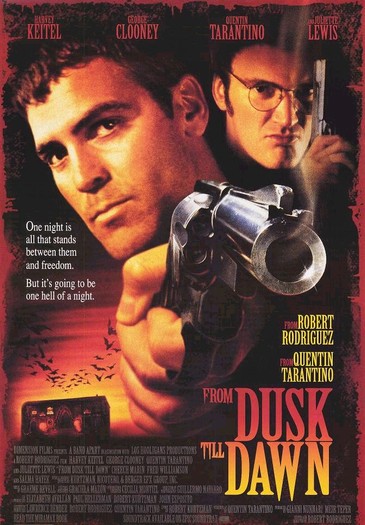
Review: From Dusk Till Dawn

Cross posted at Epinions


Call me crazy but I had to be convinced that George Clooney was hot. What was I thinking, right? Alas, it’s true, for a long time I didn’t believe the hype. Why did I change my mind? Well, I watched Quentin Tarantino and Robert Rodriguez’s insane action flick From Dusk Till Dawn. I was convinced in about five minutes.

Before Sin City, before Pulp Fiction, there were a couple of kids on the brink of making it big. Making it Huge in point of fact. Fresh off of their successes with El Mariachi (Rodriguez) and Reservoir Dogs (Tarantino), the two were wandering around that little place known as Hollywood. Friends from working together previously on the film Four Rooms, Tarantino showed Rodriguez his script for From Dusk and Rodriguez wanted to start production the very next day. They didn’t start quite that quickly, but in 1996 Rodriguez did get his wish. The collaboration was history in the making. Now both of those kung fu loving buddies are huge and their names are synonymous with indie cinema (whether or not they’re actually indie is a debate for another day).

From Dusk Till Dawn isn’t meant to be taken seriously. It’s an adrenalin shot. There’s action, explosions, blood, gore, monsters, and murder. After a purposefully slow opening conversation between a Texas Ranger and a liquor store clerk, the bullets start flying and the pace never again slows. This movie is the epitome of a Tarantino or Rodriguez picture. It’s not about art or drama or having any kind of socially redeeming value. It’s about creating fast moving, witty, violent entertainment. It’s all about having fun.

George Clooney is the anti-hero of the film. He plays the murdering bastard Seth Gecko. Along with his brother Ritchie (played by none other than Lord Quentin himself), Seth is making a run for the Mexican border after a daring escape from the law and bank heist. Seth and Ritchie know that they won’t be able to make it past the lawmen on their own so they grab the disillusioned preacher Jacob (Harvey Keitel) and Jacob’s two children Kate (Juliette Lewis) and Scott (Ernest Liu). The five make it into Mexico riding in Jacob’s RV and head to one very hellish club. They are only one night away from freedom but they soon find that making it through that night is going to be harder than they imagined. It’s not just any bar that they’ve walked into; it’s an ancient vampire feeding ground. Needless to say, things get very, very bloody.

The structure of the film is an interesting one. It’s almost like watching two different movies spliced together. The first is a crime flick while the second is a horror/action combo. We don’t even see a vampire until incredibly late in the film. It’s a formula that really, really shouldn’t work. It does though. While the first half of the film tries to play it fairly straight, it’s still pretty over the top and ridiculous. The actors are all putting in their fair share of cheese and the campiness bleeds right into the plausibility of a vampire encounter in some trashy Mexican trucker bar. I buy it.

I really can’t stress enough how silly this movie is. It’s okay though. It doesn’t pretend to be anything that it isn’t. And it has a lot of things going for it. Harvey Keitel for one thing. The man is great. Even when the situation is just completely ludicrous, Keitel plays it straight and his performance is first-rate throughout. Juliette Lewis is also wonderful. She doesn’t play her character nearly as seriously as Keitel’s Jacob but she is one hardcore chick. In the second half of the film there are also a few exciting cameos. The incredibly beautiful Salma Hayak makes an appearance as the lusciously dangerous vampiress Satanico Pandemonium (that’s a name for you). We get Cheech Marin not once, not twice, but THREE times. But my personal favorite appearance: Tom Savini as the trucker known only as “Sex Machine.” Man, does that boy have some weapons on him.

On the flip side, it also has Tarantino in one of the larger roles. He may be able to write, he might even be able to director, but he cannot act. He’s just lucky that in a film filled with ridiculous things, Ritchie is supposed to be the most ridiculous.

The star of the show is Mr. ER himself, George Clooney. Which is no accident. Rodriguez does it on purpose. He frames Clooney so that he’s always above us, always speaking too us, we are forced under his spell. It’s almost violent the way he’s thrust upon the audience. Not that I’m complaining. When he looks down the barrel of that gun, the shiver running down my spine has absolutely nothing to do with fear. Rodriguez gave Clooney the chance to prove that he could be a big time star. Clooney proves it with power. And the neck tattoo certainly doesn’t hurt…

While I wouldn’t call this movie brilliant, it’s not terrible either. It’s pop entertainment. It’s meant to shock, it’s meant to make you laugh, and it’s meant to make you think “Man, that was Mother F***ing Bad A**”. It’s about as far from highbrow as you can get.

Now for the DVD. For the price, it’s definitely a worthwhile purchase. I picked it up at Sam’s Club for $8 and change. It’s a Dimension film and it was released as a Dimension DVD. The Collector’s Series edition that they have at Sam’s is a two-disc set filled with juicy features. Rodriguez loves to give it to his fans. Bonus materials include: Feature commentary with Rodriguez and Tarantino, Outtakes, Deleted Scenes, Theatrical Trailers, TV Spots, a couple of featurettes, Music Videos, Cast & Crew bios, and the feature length documentary Full-Tilt Boogie (neat!) about the From Dusk Till Dawn.

Review: A Little Princess (1995)

Originally posted on 11/03/06 at Epinions


Did you know that all women are princesses? That is our right. It doesn’t matter if she is poor or old or ugly. Didn’t your father ever tell you that?

Sarah Crewe’s father told her.

Sarah’s story is one that has been loved by generations of little girls. From the novel by Frances Hodgson Burnett (the author of The Secret Garden as well) to the Shirley Temple adaptation as well as several other adaptations (including a popular version for television in 1986) and, in 1995, to this adaptation it’s a story that has awakened the imagination.

Before Harry Potter and Y tu mama tambien, Alfonso Cuaron brought his magical touch to this, a very magical story. Working alongside Emmanuel Lubezki (the two collaborate frequently), Cuaron brings the story to life in the most touching way.

The year is 1914 and little Sarah leaves India for a New York boarding school when her father is sent to war. Miss Minchin’s school is a cold place of rules and proper conduct but Sarah’s imagination cannot be contained. The other girls fall in love with Sarah’s stories and even when tragedy strikes they refuse to abandon their friend. Sarah goes from royalty to scullery maid in the blink of an eye. Kindness, compassion, love, and hope never abandon or are abandoned by Sarah, no matter how dark conditions may become. With Becky by her side, Sarah dances and feasts and, always, dreams. Sarah will always be her father’s princess.

While this adaptation may not be the most faithful in detail to the novel, I really feel that it captures the essence of the story. Between the acting, the camera work, and the music, it comes across beautifully. Cuaron and Lubezki create images that are moving and just plain breathtaking. Liesel Matthews is enchanting as Sarah. And as Sarah walks, the music swells, the leaves dance and even the cold New York City streets seem filled with the magic she carries with her. Every element in this film blends seamlessly together, all working to bring the magic of A Little Princess to life.

Liesel carries the film as the lead but the rest of the cast is just as superb. From Liam Cunningham who plays Captain Crewe to Eleanor Bron as the wicked Miss Minchin, the cast is filled with gems. Vanessa Lee Chester is Becky, Errol Sitahal is the neighboring Indian servant Ram Dass, Heather DeLoach is the timid Ermengarde, Taylor Fry is the bully Lavinia, and Kelsey Mulrooney is the little banshee Lottie. The girls are mischievous imps all too ready to listen to an imagined story or embark on a life threatening adventure. Paternity suits Liam Cunningham well and in Miss Minchin’s eyes you can see the disillusionment and bitterness as well as the memory of abandoned hopes and dreams. Ram Dass is a mystery and heroic in his own quiet way.

What makes A Little Princess so special though is how it is able to transcend the state of being only entertainment. A Little Princess is so much more. When watching you can feel the magic that Sarah and her father talk about wrap around you. It sneaks into your heart and by the ending you are completely captured by this world. Yes, I’ll admit it, I cried. A Little Princess was the first, and one of the only, films to ever strike such an honest note with me. I feel Sarah and her father so completely. This film is a rare thing indeed.

It’s also a family film. It’s intelligent and well done but maintains a sense of innocent fantasy that parents can share with their children without worry. It is a story for little girls after all, a story for the princess in all of us.

About This Thing

This blog is about film and life in the wonderful world of LA. I'm a filmmaker just getting started; I'm navigating my way through the industry, trying to find work, and sometimes even managing to make a living.

I've worked across the country on projects big and small. Everything from an indie in PA shot during the dead of winter to one of the bigger reality shows involving Models and the things they do.

I also just love doing things*. I'm a writer, aspiring director, wannabe photographer and cook. I waste too much time on the internet and sometimes all I want to do is hang out with my dog.

Stick around and chances are you'll catch me writing about it all.

*I use the word "thing" a lot. An inappropriate amount. I can't help it. There are just so many different things to talk about. And I just kind of like it.